Pages

Showing posts with label AMERICAN. Show all posts

Monday, December 18, 2017

ASHLEY DEQUILLA


“I don’t think about it, I just go for it.”
--Ashley Dequilla Black

I shared a class with fellow William & Mary student Ashley Dequilla in 2007.  Under the tutelage of Professor Brian Kreydatus, we holed up together in the Matoaka Art Studio from winter until spring, our hands silver with lead as we toiled away at Life Drawing II.  That semester, the picturesque location on the lake was worth the windy walks from Old Campus, and three-hour studio sessions with live models, accompanied by George Harrison on a cassette player, lead to some of my best student work. Then I graduated.  I lost touch with Ashley, despite our camaraderie through critiques at Matoaka, though I remained wistful of those long afternoons and evenings on the lake. 

In the decade since our shared studio experience, Ashley and I both maintained our respective artistic practices.  Ashley’s art career has included several exhibitions and a significant portfolio of artwork dealing with themes of re-indigenization and exploration of her Filipino heritage.  My own artistic practice lead me to use clothing as my canvas, creating wearable art inspired by modern and contemporary art masterpieces; ultimately establishing my website and clothing line, Artfully Awear.

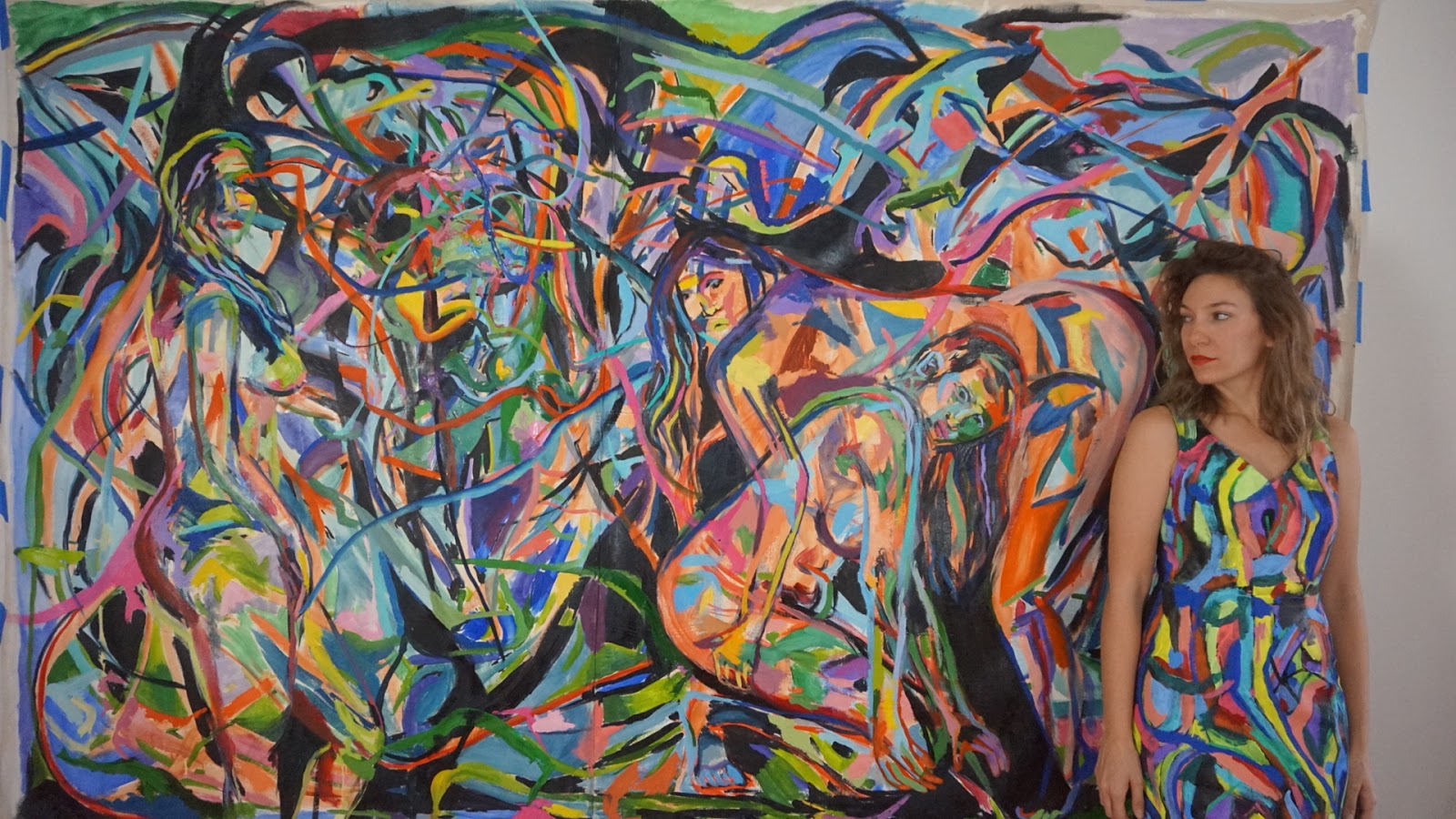
When we reconnected recently via social media, Ashley and I discovered an affinity to each other’s work, and bonded over the struggles and triumphs of developing and maintaining an art career.  I was intrigued by the issues she explores through her painting, and she was interested in the way that I use clothing to examine and understand the meaning of art.  In a Facebook message, she attached an image of one of her works, a large-scale painting entitled Psyche, and asked if I’d be interested in creating a garment inspired by the work. I immediately noticed something exciting in the piece – the gestural abstraction and color palette caught my eye, and I had so many questions about her process.  We agreed to collaborate, and I began the process of creating a dress inspired by her painting.

Understanding the artists’ processes and inspirations is the most important part of what I do through Artfully Awear. Making my own garment inspired by a work of art is the ultimate learning experience – to put myself into the mind of the artist and figure out how it was made gives me a very deep understanding of his or her challenges and how they were overcome.  In a long conversation with Ashley, we delved into the meaning behind her work, and I began to understand and appreciate it much more deeply.

Black is based just outside of Washington, DC, where she has been expanding her artistic practice over the past several years. Of her work, she says, “I think of painting as an alchemical practice—meditative—mixing ingredients and components which becomes a tangible spiritual practice and release.”  The convergence of many disparate elements is evident in her work, where the palette and subject matter run the gamut, referencing Mexican Renaissance painting, German Abstract Expressionism, and Neoclassical Baroque Renaissance painting. Her work is a hybrid of elements taken from all of her inspirations, with their own underlying themes: complex mythologies, the exploration of archetypes, religion, witchcraft, and the work of Carl Jung.  In the particular work I was studying, Psyche, Black explored the marriage of figurative work and abstraction—striving for inhibition through her process.  Of her vibrant color palette, she says, “Whimsy informs my palette choices.  I don’t think about it, I just go for it.”  You can truly feel this urgency in her work, as she explores themes related to gender and cultural heritage.

I created the dress inspired by Psyche from my own studio in Brooklyn, NY.  While I was working on it, I sent photos to her so she could see the process and provide input.  Her advice: “allow the final mark-making to be entirely random.”  Inhibition isn’t something that I explore as much in my work; fabric is less forgiving, and, similar to watercolor, each mark is permanent. But once I started to get into the rhythm of painting in Ashley’s style, I realized that it was absolutely necessary to release control in order to obtain the essence of her work.  That lesson was the most valuable part of this project for me, useful in life as in art – learning to let go and allow the work to grow, uninhibited.

When the dress was finished, I packed it up and traveled from New York City to Washington, DC, to solidify the reconnection between Ashley and myself and between our work.  Over black coffee, she and I talked through the process and connected over some of our similar struggles.  Then we took some photos of the two pieces together, and of us, recording this collaboration that began a decade ago at Lake Matoaka.  In many ways, it felt like a homecoming – the two of us, nearly a decade after our William & Mary art classes, collaborating once again.  Auspiciously, we’ve learned a few things along the way, such as the value of releasing your inhibitions and letting your creative spark guide you.


Wednesday, June 1, 2016

CLYFFORD STILL MUSEUM


“You can turn the lights out.  The paintings will carry their own fire.” –Clyfford Still

In anticipation of my long-awaited sojourn to the Clyfford Still Museum in Denver, Colorado, I began reading and thinking about Still’s work: putting myself into the mind of the artist to create a garment inspired by his paintings.  I could count on one hand the number of Still’s paintings I’d seen in person, and could only imagine the quiet power of a building dedicated entirely to his life’s work.

Still (1904-1980) was a contemporary of Jackson Pollock and Mark Rothko, but unlike other artists, he eschewed the market for his work.  When he passed away in 1980, his estate included 95% of his oeuvre, most canvases shielded from the public for decades, until the Still Museum opened in 2011.

When I anxiously opened the doors to the museum, I experienced an overwhelming sense of calm.  It is a quiet, reflective space, with soft light and nuanced architectural details that perfectly coexist with the selections of the nearly 3,000 works in its collection that are on display.

Wearing my handpainted dress inspired by Still’s artwork, I experienced a heightened sense of awareness and understanding of the connection between the works and the sublime.  It’s difficult to describe the feeling of being surrounded by Still’s paintings – on the walls around me, and on my body.  Sensing the works’ symbolism of the human condition; feeling and knowing the process of creating the works of art; understanding their conservation and relation to the history of art in America and the world; the entire process awakened in me a deeper understanding of the personal impact of painting.

I made a number of friends at the museum – including a security guard who, with a wink, remarked “that would be a great way to sneak a painting out of the museum.”


I didn’t physically take a painting from the museum that day, but I feel as though I took away my own personal collection, along with a greater sense of appreciation for Still’s work.  Along with that, I refueled my desire to create, in order to achieve the higher level of enlightenment that so many have experienced through the quiet reverie of the work of Clyfford Still.

Dress: thrifted, painted by me
Sandals: Frye Brielle Gladiator (available here)
Photos by William Sealy


Thursday, October 15, 2015

ACTION PAINTING


Hans Namuth photograph of Jackson Pollock, 1950

Hans Namuth photograph of Jackson Pollock, 1950


Hans Namuth photograph of Jackson Pollock, 1950


It was a stunning fall day; the type of day which makes you feel guilty for doing anything but frolicking outdoors.  I'd been wanting to do an action painting project for a while, and with a visit to the Pollock Krasner House & Study Center upcoming, it was time to make something to wear.  After looking through countless photographs of Jackson Pollock creating his drip paintings (most of them taken by Hans Namuth ca. 1950), I was ready to embark on my own paint-flinging experience.

First, I found a dress at the thrift store in a thick cotton fabric which resembled canvas.  I used an old sheet as a dropcloth, and spent some time mixing acrylic paint to the right consistency.  (Pollock used house paint.)  Then I took everything up to the roof of my building, set up my camera and tripod, and went to work.

I used one of Pollock's most famous paintings, Number 1, 1950 (Lavender Mist), as my inspiration, and created multiple layers of black, some white, and a lavender color.  I waited for each color to dry in between layers so they wouldn't mix and become muddy.

Overall, it was an extremely fun project and a great stress reliever!  I left the back of the dress unfinished, because some of the paint bled through and it reminded me of what the back of a painting would really look like.

On a side note, I've had great difficulty finding out how to attribute Namuth's photographs of Pollock.  It seems that many of them are courtesy of the Namuth Estate, and most are copyrighted 1950.


Photos by me; Pollock photos from various sources, all courtesy of the Hans Namuth Estate.

Thursday, April 30, 2015

TBT: Morris Louis


I spent last weekend in Washington, DC, and visited the Hirshhorn Museum and the Phillips Collection, which both reminded me of my love for the work of Morris Louis.  The most well known Washington area Abstract Epressionist, Louis' Color Field work has always been very soothing to me.  See my post from 2011 here, wearing one of my favorite dresses (that needs to come back into rotation for spring).

Saturday, August 2, 2014

HBD, Arthur Dove


"We cannot express the light in nature because we have not the sun. We can only express the light we have in ourselves." 

Happy birthday to Arthur Dove, the author of this quote, born on this day in 1880.  Dove is often considered to be the first American abstract painter.  Outfit details and more here.


Thursday, May 29, 2014

PSYCHEDELIC CLOUDS


As a child, I was fascinated by the pulsing colors and spectra of works by Peter Max.  Born in 1937, Max created colorful illustrations throughout his entire life across all media, and in partnership with many large companies, such as the USPS and 7-Up, which made him a cultural phenomenon.  He is most notable for his psychedelic landscapes with jubilant figures that seem to characterize the "Cosmic Sixties".  Max still lives and works in New York City, and his work remains a source of inspiration for me, both in the color palettes and compositions which recall one of my favorite decades in fashion and in art.

Dress: L'Amour by Nanette Lepore
Shoes: Kelsi Dagger
Bag: Rebecca Minkoff 

[Photos by Kathy Paciello; Max images from pri.org, blogs.sun-sentinel.com.]

Wednesday, November 13, 2013

Mike Kelley at MoMA PS1


The full-museum retrospective on the late Mike Kelley at MoMA PS1 opened a few weeks ago.  I attended the opening in my self-made Kelley-inspired pom pom jacket, but it's taken me a few weeks to develop my feelings about the show and begin to understand the overwhelming experience.


First of all, it is not an exhibition that can be confronted in one visit.  There is just too much -- so many extremely different, opposing mediums and ideas -- that it requires more than one sojourn in order to begin to even scratch the surface of the meaning and intent of Kelley's oeuvre.


Kelley created work that spanned a 30-year career in almost every medium imaginable: assemblage, film, works on paper, painting, sculpture, digital, installation, and on and on.  Much of this work deals with themes of isolation, repressed memory, sexuality, self-exploration.  My personal favorite work is Deodorized Central Mass with Satellites (1991), which I planned ahead to emulate with my pom pom jacket.

However, one of the most poignant pieces in the exhibition is Lumpenprole and Ageistprop (above).  A vast knit blanket stretched across the floor, concealing unidentified lumps beneath it, this work is the perfect example of Kelley's interest in repressed memory, and the way he consistently returned to previously explored themes throughout his widespread career.  While I was viewing the work, another museum attendee held his iPhone poised at the ready in order to catch the movement of the mysterious shapes (spoiler alert: they don't move).  This anecdote is a perfect example of my experience of the show: the feeling that there is something lurking around the corner that could change or develop at any moment, without notice.

Jacket: DIY
Dress: H&M
Shoes: United Nude
Clutch: Betsey Johnson
Photos by Kathy Paciello; Lumpenprole image from hamptonartshub.com.

Thursday, November 7, 2013

INSPIRATION: A Tribute to Rothko.


I love these beautifully simplified photographs by Eddy de Azevedo.
As a tribute to Mark Rothko, photographer Azevedo has captured everyday Color Field occurrences, and I've found these stacks of clothing particularly compelling.
See more images here.

Tuesday, May 14, 2013

ARTFULLY AWEAR + PANTONE: Emerald.


After a brief hiatus, I'm back with my latest Artfully Awear + Pantone post, featuring the Color of the Year: Emerald.
Emerald has always been one of my personal favorite colors, and is surprisingly flattering with almost any skin tone. The hue is also well represented in the work of Helen Frankenthaler.


Her oversized canvases, though seemingly abstract, were often inspired by landscapes, such as her most famous work, Mountains and Sea, which measures 7 feet by 10 feet.


One of the few female artists recognized alongside the group of second generation Abstract Expressionists, Frankenthaler (1928-2011) was a Color Field painter.


The thin veils of paint that make up her paintings are reminiscent of watercolors, even though they are actually oils. Her "soak stain" method of thinning oil paint and applying to unprimed canvas was adopted by other artists including Morris Louis and Kenneth Noland.

Two of my favorite posts of all time are inspired by Morris Louis and Kenneth Noland.


Color Field painting was different from Abstract Expressionism in its denial of emotional or mythical themes.


"You have to know how to use the accident, how to recognise it, how to control it, and ways to eliminate it so that the whole surface looks felt and born all at once". --Helen Frankenthaler


Dress: Nicole Miller Artelier (full length version here for $100!)
Shoes: Calvin Klein


[Photos by @kay_elle_pea; images from stylesight.com, newcriterion.com, justalittlegreen.tumblr.com, and accidental-brilliance.com.]