Pages

Showing posts with label GERMAN. Show all posts

Thursday, October 23, 2014

ANSELM KIEFER at MASS MoCA


One of the most outstanding aspects of my first visit to MASS MoCA was the long-term Anselm Kiefer exhibition, on view through 2028.  Kiefer is arguably the most important post-war German artist, and his work deals with many themes related to his home country's struggle after World War II.

Kiefer was born in Germany in 1945, and the rebuilding years after the war are his first memories.  His work deals with history directly, through the use of varied materials like photographs, organic matter, and post-industrial building materials.  It has been described as apocalyptic, and that term comes to mind easily when confronted with the size and scale of the works in the MASS MoCA exhibition.

In its own building separate from the rest of the museum, the Anselm Kiefer exhibition, in collaboration with the Hall Art Foundation, is like a memorial, and the quiet within the space attests to the ___ with which the images and forms are imbued.

Dress: Marni
Necklace: Saturday
Shoes: Pour la Victoire

Photos by Kathy Paciello.


Wednesday, February 27, 2013

THE SCREAM


The Scream, by the Norwegian Edvard Munch (1863-1944), is arguably one of the most recognizable images from art history, and the 1895 pastel is on view at the Museum of Modern Art.


 Since the pastel debuted at MOMA, it has become even more of a popular icon, with a steady stream of social media hype as well as a lengthy line to enter the gallery where it hangs.


The dark subject matter, symbolism, and macabre nature of the figures in his work have become ubiquitous with German Expressionism, a movement for which Munch was a forerunner.  The Scream is one of the greatest examples of this style.


In 2012, the 1895 pastel sold at auction for over $119 million, the most expensive work of art ever sold at auction.


At the Museum, it's nearly impossible to catch a glimpse of The Scream through iPhone-wielding arms.  How poignantly our smart phone culture has changed the museum experience, particularly when a cultural icon is in the room.


Blouse: Diane von Furstenberg (similar)
Skirt: Vintage, thrifted
Tights: H&M (similar)
Necklace: Vintage, belonged to my mother


Photos by @kay_elle_pea in the Sculpture Garden of the Museum of Modern Art.
Munch images from moma.org

Tuesday, December 20, 2011

MARSDEN HARTLEY

DSC_0064

This scarf reminded me of the work of Marsden Hartley, an artist I always encountered when reading about American art of the 20th century, but whose work I never really investigated.  


DSC_0066

Hartley (1877-1943) was an American Modernist painter, poet, and writer, born in Maine.

corcoran_0308_16

Hartley's work was shown alongside many other well-known American artists, such as Georgia O'Keeffe and Charles Sheeler, at Alfred Stieglitz's legendary 291 Gallery in New York.


Though Hartley traveled extensively throughout the United States, and was eventually categorized as an authentically American artist, he also lived in Europe and was greatly influenced by German Expressionism, and inspired by German military pageantry, as seen in the works shown here.

marsden-hartleye28094painting-no-47-berlin-1914-1915-oil-on-canvas-hirshhorn

While in Europe, Hartley became acquainted with Gertrude Stein, Wassily Kandinsky (discussed here), and Franz Marc (recently discussed here), each of whom had a distinct influence on his work.

Marsden-Hartley-Portrait-of-a-German-Officer-1914-painting-artwork-print

In the later years of his career, Hartley moved back to the U.S., and became a part of the Regionalism movement, depicting scenes of local life in both his paintings and his writing.

DSC_0062

Hartley considered his art a spiritual journey, and found great meaning in symbolism.

DSC_0056

"My work embodies little visions of the great intangible..."
--Marsden Hartley


DSC_0069

Wool coat: vintage, thrifted
Scarf: thrifted
Riding pants: Tahari
Leather boots: Franco Sarto (also worn here and here)
Socks: Gold Toe (also worn here)
Leather purse: vintage (also worn here)
  Striped tunic: H&M
Leather gloves: Urban Outfitters

DSC_0035
[Hartley images from arthistory.about.com, oilpainting-frame.com, venetianred.net, and triviumproject.com, respectively.]

Wednesday, November 30, 2011

FRANZ MARC

DSC_0055

The colors I wear are always very specific, expressive choices, related to my mood or surroundings.  This is an ideal that I share with the late German Expressionist Franz Marc.

DSC_0057

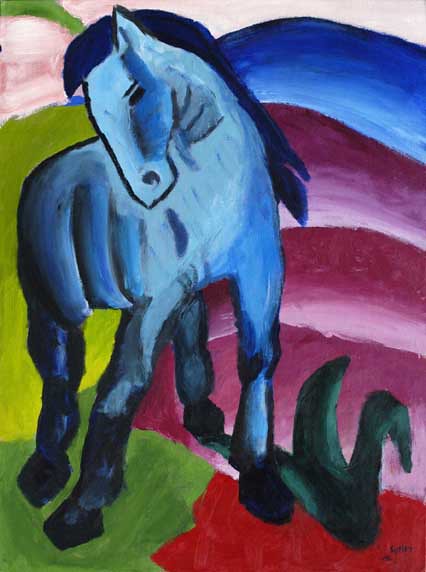
Marc (1880-1916) was a painter and printmaker, and one of the founders of the artistic collaborative known as Der Blaue Reiter (The Blue Rider).

Franz-Marc-024


Along with Auguste Macke and Wassily Kandinsky, Marc founded Der Blaue Reiter journal in 1911, which became synonymous with the German Expressionist movement in Munich.
View my Kandinsky post here.


llr_lams_l_f10_1944_0_0_624x544

In 1912, Marc met Robert Delaunay, who greatly influenced Marc's artistic shift toward Futurism.

Franz_Marc_022

Within months after being sent to the front in World War I, Marc was listed as a notable artist and was slated to be removed from combat.  However, he was killed in battle in 1916, before he could be sent home.

Blue Horse, another painting, Franz Marc

For Marc, particular colors had very specific meanings.  For example, blue signified masculinity or spirituality, and red symbolized violence.

DSC_0033

"Art is nothing but the expression of our dream; the more we surrender to it the closer we get to the inner truth of things, our dream-life, the true life that scorns questions and does not see them."    --Franz Marc

DSC_0056

I'm wearing a vintage silk blouse, thrifted Ellen Tracy silk skirt, vintage cardigan, Urban Outfitters socks, whistle pendant from the Brooklyn Flea, and Marni shoes.

DSC_0060
[Marc images from artmight.com, Leicester Arts and Museums Service, wikimedia.org, and karlshuker.blogspot.com, respectively.]

Tuesday, May 10, 2011

INDIVIDUALITY


One of the easiest ways to understand art is by examining the intersections between various artistic disciplines; for example, the relationship between clothing and art.


Paul Klee (1879-1940), a German and Swiss painter, straddled artistic media and styles, as well as various disciplines, including visual art, music, theory, and poetry.


In my last post influenced by Klee, it was striking to see the range of differences between the works, as well as the shared color and shape sensibility. Whether painting, drawing, writing, or music, Klee's work is relatable across media.


I personally find it most enlightening to read his poetry as a companion to his artwork.


Individuality?
is not of the substance of elements.
It is an organism, indivisibly
occupied
by elementary objects of a divergent character:
if you
were to attempt division, these parts
would die.

Myself,
for instance: an entire dramatic company.

--Paul Klee


Inspired by Klee's work, I wore a dress and hat reminiscent of his palette and favor for geometric shapes, yet reflected my personal sense of style and individuality, like all artistic interpretations.


I'm wearing a Marc by Marc Jacobs dress, Cynthia Rowley x Roxy sandals, Juicy Couture straw tote, and a straw hat by Maria Bonita Extra.


What does individuality mean to you?


[Klee images from allpaintings.org, poetry4beauty.blogspot.com, and chinaoilpainting.com, respectively.]

Tuesday, May 3, 2011

EDELWEISS


Immediately after I become acquainted with a new body of work, I begin seeing relationships between the work and things in my wardrobe.


For example, I've owned this dress for some time, but suddenly I couldn't look at it without seeing the collage works of German video artist Marcel Odenbach (b. 1953), whose work I recently discovered via the MoMA.


Odenbach's background in art history, architecture, and semiotics has provisioned him a wide lens through which to view the concept of identity. Odenbach uses symbolism, like the edelweiss depicted above, to add multiple levels of meaning to his work.


Central to Odenbach's work is the subject of German national identity, as complicated by the Holocaust, and how this is reflected in the life of the contemporary individual.


Though video installations form the basis of his work, Odenbach often accompanies these works with related performances, drawings, and collages, pictured here, which are reminiscent of Cubist an Dadaist collages.


By using a multimedia approach, Odenbach is able to address similar issues from a multitude of angles. Click below to watch a lovely short video in which Odenbach discusses the above work, You Can't See the Forest for the Trees.


If you can't see the screen, click here to watch the video.


The multiple black and white prints that make up this dress have a sort of collage effect that resembles Odenbach's works, and the little floral print is reminiscent of edelweiss.


I'm wearing a Walter dress, Madewell necklaces, Rebecca Minkoff purse, and Halston Heritage espadrilles.


Thank you to Lydia for the One Lovely Blog award and to Allie for mentioning me in her Inspiration post!
Also, I was featured along with some other stylish ladies in What I Wore's Rainy Day Challenge. Check it out here!

[Odenbach images from moma.org, flickr.com, nyclovesnyc.blogspot.com, and katiephoto.tumblr.com, respectively. Video from moma.org.]